.
 Dr. Paul Cameron is a research scientist from Australia who frequents this forum to promote the neo-Darwinian perspective within the Christian tradition. I think it important to carefully consider his arguments because I believe him to be honest and sincere in his beliefs and to represent many if not most mainstream scientists who also consider themselves to be Christian to one degree or another.
What surprises me, however, is that Dr. Cameron seems to recognize at least the potential for limitations to the Darwinian mechanism of random mutations and natural selection to explain the existence of complex biological systems beyond very low levels of functional complexity. This is interesting because it is quite unusual for any evolutionary scientist to even hint at such a limitation to what is seen, by most, as the “sacred cow” of mainstream evolutionary biology – i.e., the creative potential of natural selection to take the raw material that random mutations provide and use that to create all of the wonders and diversity of life that we see today.
During an extended discussion on how limited the Darwinian mechanism is, how it can only explain diversity at very low levels of functional complexity (i.e., novel systems that require less than 1000 specifically arranged amino acids to perform their functions) within what anyone would consider a reasonable amount of time, Dr. Cameron argued that it matters not if the Darwinian mechanism is limited in its creative potential. Why not? Well, here’s his argument in his own words:
Your arguments based on statistical improbability of natural selection is like arguing that H2O2 does not exist because the thermodynamic stability for 2H2O2 -> H20 + O2 is so high that the reaction can never go the other way. Of course in reality there is such a thing as H2O2 and it is very useful so any statistical argument is moot. How does this unstable and statistically improbably chemical exist? by clever chemistry… You assume you know all the variables in your statistical models but overlook the possibility that this is completely voided by the catalytic and enzymatic properties of life…
The point is not whether or not random mutation and natural selection is responsible for all of evolution but that evolution occurs and there is no clear limit to this process. You concatenate the 2 questions by arguing that since neo-Darwinian models of selection has limits then evolution cannot occur…
I am asking do you have absolute knowledge of all the possibilities for the trajectory of sequence change in an individual molecule within a highly complex collection of organic material within a cell?
You cannot conceive of it but assume that you can nonetheless deny all possibility. I guess it does fit with your assumption that you can know everything in science or religion…
I do not pretend to know much of the immensity of existing human knowledge much of which is documented in the scientific literature. I admit I am ignorant on many things, but on the possibility of a natural law explanation for much of the physical universe I appeal only to the history of science which has for the last 300 years progressively explained the natural world by natural process and natural law without recourse to miracles. Nowhere is this better illustrated than in modern evidence based medicine of which you are of course a part. Why if you no longer explain disease in terms of humours, spirits and demons do you not admit to the same processes in other areas of biology? To me it seems blindingly obvious.
It is you, not me, [who] is appealing to supernatural explanations after you conclude, based on incomplete knowledge and data that some things that most of science for the last 150 years has considered likely of natural cause is naturally impossible and can only be explained by a celestial intelligent designer.
For me, this line if reasoning is fascinating – especially coming from a life scientist like Dr. Cameron. The argument he forwards is that one doesn’t need to know how the mechanism works or how the job was done before one can know, with perfect assurance, that, however it was done, it was done via some kind of mindless non-deliberate naturalistic mechanism – such as some as yet undiscovered “life enzymes” to explain anything that natural selection might not be able to explain. He knows this because throughout history pretty much all of what were originally thought to be “acts of God” expressed in nature have turned out to have perfectly good naturalistic explanations. Therefore, such discoveries will always be found to explain anything and everything that might seem to us today to be truly an artefact of intelligent design.
Is this not a problem for science? No longer is research or testable experimentation needed to support Darwinism or mindless naturalism in general. All that is needed is an assurance that even if the information isn’t yet in hand, that it will one day be discovered. How comforting for those who already know the truth and power of a mindless Nature and her fantastically creative, even God-like, abilities.
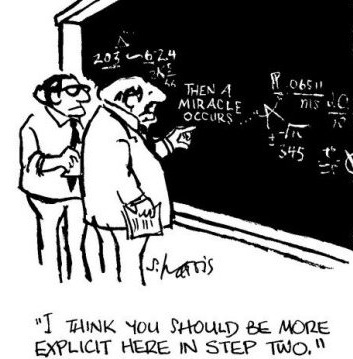 The problem, for a real scientist anyway, is that such a position is not a testable potentially falsifiable science. It is a “God of the Gaps” philosophical position, rooted in blind-faith, not actual evidence in hand, that the philosophical position is true regardless of all appearances and evidence to the contrary.
Strange, isn’t it, that a scientist who does science for a living would think to appeal to a GoG argument? But, it’s true. Creationists aren’t the only ones who fall for this argument on occasion. Scientists, when pressed on the issue, also appeal to a GoG argument even though the “designer” they appeal to isn’t intelligent and does not create with deliberate intent. Yet, this designer, Nature Herself, can explain anything and everything with an appeal to evidence, evidence that is not yet in hand but that will certainly be found in the future, to support this conclusion of a mindless creation of everything that exists.
This position isn’t just unscientific, it is anti-science. It undermines the very basis of science itself.
For example, let’s say that SETI scientists discover what they claim is a clear example of an artefactual radio signal coming from outer space. At this point, Dr. Cameron’s very same argument could be used to say, “There’s no way that these SETI scientists can be absolutely sure of their conclusion in favor of intelligent design to explain this radio signal because history has shown that all such apparent artefacts will one day be proven to be the result of some as yet unknown mindless naturalistic mechanism.”
 See the problem? One could argue the very same thing for the classic example of a highly symmetrical 1 x 1 x 1 meter polished granite cube found on Mars. In fact, given Dr. Cameron’s position, it would be impossible to present anything that he would accept as being a true artefact of deliberate design because he could always argue that we are ignorant of the totality of information and therefore cannot accept the artefact hypothesis for anything until we become omniscient.
What an interesting conclusion coming from, ironically, a man who does science for a living. This is interesting because Dr. Cameron’s position depends upon and actually invokes omniscience as the only thing that can oppose or potentially falsify his position. He seems to demand absolutely definitive proof before he will even think about changing his mind. That, of course, is a philosophical position – not a true science that is based, not on absolute proof, but upon the weight of evidence that is currently in hand.
Table of Contents
.
The unbelief that demands perfect knowledge will never yield to the evidence that God is pleased to give. He requires of His people faith that rests upon the weight of evidence, not upon perfect knowledge.
There are many who believe without a reason on which to base their faith, without sufficient evidence as to the truth of the matter. If an idea is presented that harmonizes with their own preconceived opinions, they are all ready to accept it. They do not reason from cause to effect, their faith has no genuine foundation, and in the time of trial they will find that they have built upon the sand.
Ellen White, Mind, Character, and Personality, Vol 2, p 535; and The Ellen White 1888 Materials, p 403