From an interesting E-mail exchange I recently had about the “science” of detecting God’s signature in nature:
Why to you have to jump from “we don’t understand the natural explanation for this” to “it must have been designed by something unnatural?” As scientists we pursue NATURAL explanations for NATURAL things. Are you redefining or resorting out things in our world into “Natural” ones and “So Complicated It Couldn’t Be Natural” categories? If so you are making a VALUE JUDGEMENT. You can’t do that and call yourself a scientist.
Sincerely,
Dr. X
Instructor of Biology

Hi Dr. X,
I understand your argument that scientific methodologies can only deal with the empirical world and can therefore only propose natural explanations for these natural phenomena. Of course science cannot study much less demonstrate “God” or the “supernatural” – right?
 Consider that there are different types of explanations in science… all of which are “natural” in their own sphere – but are clearly within different “spheres” or “levels” of what might be considered “natural”. For example, consider a highly symmetrical polished granite cube that measures 25 cm alone each edge – with perfectly symmetrical geometric etchings (like triangles, squares, hexagons, etc.) carved into the middle of each face of the cube. What do you think would be the best scientific explanation for the origin of such a granite cube? Let’s say that one of our robotic rovers on Mars happened to come across such a granite cube sitting right there on the surface of Mars. Do you not think that the vast majority of scientists would recognize such a granite cube as a true artifact of deliberate design? Of course they would, and so would everyone else with a candid mind. It would hit the front page of every newspaper in the world with the heading, “We are NOT Alone!” – and for very good reason.
Clearly, the best and most reasonable explanation or hypothesis for such a phenomenon would require the involvement of at least human-level intelligent design. How so? Because, there are no known mindless natural mechanisms that could come close to doing the job while, at the same time, we know that at least human level intelligence is capable of easily producing such things. Given these two pieces of knowledge the hypothesis of intelligent design becomes the best scientific explanation among the competing options.
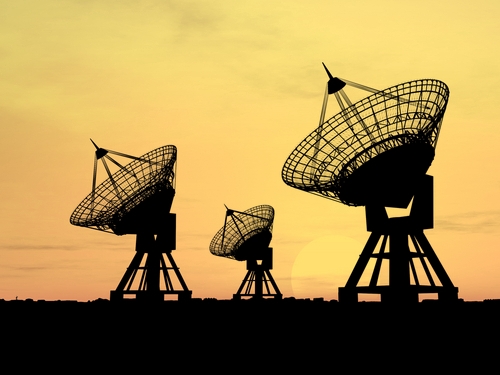 After all, this argument forms the very basis of various modern scientific disciples such as forensic science, anthropology, and even SETI science. All of these modern sciences are entirely based on the human ability to rationally detect the workings of intelligent design behind various natural phenomena that are or that might be seen in nature.
Of course, this doesn’t mean that the designer of the granite cube or the SETI radio signal was God or any other supernatural being. It’s much more likely that if such phenomena were ever discovered that some form of “natural alien intelligence”, similar to humans perhaps, produced these “artifacts” of intelligent design – right? This is a very reasonable argument to be sure. However, consider that not everyone who is intelligent is at the same level of intelligence. Some phenomena, while requiring intelligence to explain (like our granite cube) do not require very high levels of intelligence to explain. Could God or a God-like being have been responsible? Sure! However, the hypothesis of God-like intelligence and creative power is not required to explain the origin of such a granite cube – right? Much lower levels of intelligence would work just fine.
 However, let’s say that our Mars rover came across something that looked very much like a mechanically-intricate spaceship. Let’s even say that, after investigation, it was discovered that technology previously unknown to us, and perhaps still very mysterious, was used by the creators of this spaceship to enable the spaceship, and anything inside of it, to go back in time. Clearly, not only would such a spaceship be very excellent evidence that its creators were highly intelligent, it would strongly suggest that they were a great deal more intelligent, or at least had access to a much higher level of knowledge, than humans currently have. So, one might reasonably argue that even if we might not yet be able to understand how such technology works, we can or could detect that whoever produced such a spaceship had greater intelligence and/or technological advancement compared to us. Of course, this doesn’t mean that these very advanced intelligent beings were “supernatural” or at all God-like! – right? Of course not. Would a God or God-like being be required to explain the origin of such a spaceship? Not necessarily – right?
However, what would it take before one could be rationally suspicious that a particular phenomenon could only be explained by a level of intelligence and creative power that, from our finite perspective at least, would be indistinguishable from what we would expect from a God or a God-like being?
 This is what many modern physicist are asking. That’s right, many, and probably most, modern physicists believe that God, or at least a God-like being, is responsible for the origin of the fine-tuned features of the universe in which we live. In order for the universe to be inhabited by intelligent beings of any kind it has to achieve an extremely high level of precise fine tuning for large numbers of variables known as “fundamental constants”. Obviously intelligent design was required to achieve a level of fine tuning far beyond what any spaceship would require to function. What type of intelligence and creative power could produce such a thing? Call it “natural” if you want, but I certainly couldn’t tell the difference if this “natural” intelligence told me, “By the way, I’m also God.” What would I say to that? I simply couldn’t tell the difference and would have no basis to argue otherwise. And, who knows, perhaps God is just as “natural” as you and me? – just on a different level of what might be defined as “natural”. After all, I’m sure that God, given that he exists, considers his own level of intelligence and creative power perfectly “natural” from his own perspective.
 Such conclusions aren’t just “value judgments” beyond noting that there are in fact different levels of intelligence and that some phenomena in nature require extraordinarily high levels of intelligence and creative power to explain. And, I’m not the only one to come to this conclusion.
For example, there are the interesting back and forth arguments from Paul Davies, and English astrophysicist. Although he is currently a seemingly conflicted atheist (Link), he was once a kind of theist and still manages to argue strongly for what seems like a nearly overwhelming impression of design that most physicists come away with when studying the fine tuned features of the universe.
The temptation to believe that the Universe is the product of some sort of design, a manifestation of subtle aesthetic and mathematical judgment, is overwhelming. The belief that there is “something behind it all” is one that I personally share with, I suspect, a majority of physicists. This rather diffuse feeling could, I suppose, be termed theism in its widest sense.1
The really amazing thing is not that life on Earth is balanced on a knife-edge, but that the entire universe is balanced on a knife-edge, and would be total chaos if any of the natural ‘constants’ were off even slightly. You see, even if you dismiss man as a chance happening, the fact remains that the universe seems unreasonably suited to the existence of life – almost contrived – you might say a ‘put-up job’.
The force of gravity must be fine-tuned to allow the universe to expand at precisely the right rate. The fact that the force of gravity just happens to be the right number with stunning accuracy is surely one of the great mysteries of cosmology…
The equations of physics have in them incredible simplicity, elegance and beauty. That in itself is sufficient to prove to me that there must be a God who is responsible for these laws and responsible for the universe.2
Davies, Paul C.W. [Physicist and Professor of Natural Philosophy, University of Adelaide at the time of writing], 1) “The Christian perspective of a scientist,” Review of “The way the world is,” by John Polkinghorne, New Scientist, Vol. 98, No. 1354, pp.638-639, 2 June 1983, p.638 (Link, Link) aand 2) Davies in his1984 book Superforce.

Nobel laureate Arno Penzias makes this observation about the enigmatic character of the universe:
Astronomy leads us to an unique event, a universe which was created out of nothing and delicately balanced to provide exactly the conditions required to support life. In the absence of an absurdly-improbable accident, the observations of modern science seem to suggest an underlying, one might say, supernatural plan.
Arno Penzias (Nobel prize in physics), Margenau, H and R.A. Varghese, ed. 1992. Cosmos, Bios, and Theos. La Salle, IL, Open Court, p. 83.

Freeman J. Dyson distinguished mathematical physicist, says,
As we look out into the universe and identify the many accidents of physics and astronomy that have worked to our benefit, it almost seems as if the universe must in some sense have known that we were coming.

Sir Fredrick Hoyle, famous British astronomer who early on (1951) argued that the coincidences of the fine-tuned universe were just that, coincidences. But, by 1953 he had evidently changed his mind and wrote:
Such properties seem to run through the fabric of the natural world like a thread of happy coincidences. But there are so many odd coincidences essential to life that some explanation seems required to account for them… A superintellect has monkeyed with physics, as well as with chemistry and biology.
http://www.leaderu.com/
offices/bradley/docs/universe. html Hoyle, Fred. “The Universe: Past and Present Reflections,” in Annual Review of Astronomy and Astrophysics, 20. (1982), p.16.

Alan Sandage (winner of the Crawford prize in astronomy):
I find it quite improbable that such order came out of chaos. There has to be some organizing principle. God to me is a mystery but is the explanation for the miracle of existence, why there is something instead of nothing.
Alan Sandage, per Willford, J.N., March 12, 1991. Sizing up the Cosmos: An Astronomers Quest. New York Times, p. B9.

Charles Hard Townes, winner of a Nobel Prize in Physics and a UC Berkeley professor noted:
This is a very special universe: it’s remarkable that it came out just this way. If the laws of physics weren’t just the way they are, we couldn’t be here at all….
Some scientists argue that, “Well, there’s an enormous number of universes and each one is a little different. This one just happened to turn out right.
Well, that’s a postulate, and it’s a pretty fantastic postulate. It assumes that there really are an enormous number of universes and that the laws could be different for each of them. The other possibility is that our was planned, and that is why it has come out so specially.


· http://www.berkeley.edu/news/
And the list goes on and on. Are these famous scientists not being scientific? – are they not being at all rational?
I don’t know about you, but it makes a lot of sense to me…
Again, all the best to you in your continued search.
Sean