 Even though the Seventh-day Adventist Church has taken a clear stand on the topic of origins (specifically endorsing and tightening its language regarding a literal 7-day creation week last summer at its General Conference Session in San Antonio, Texas – 1, 2), there are many within or closely associated with the church who still have sincere questions and even strongly held beliefs regarding the existence and evolution of life on this planet over many hundreds of millions of years. And, the church has given such voices of dissent a platform – sometimes within our schools (especially at La Sierra University where professors remain who continue to promote various forms of Darwinian evolution over vast periods of time while receiving financial support and accreditation from the church) or even behind our own pulpits. Even during the GC session in San Antonio this last summer the church gave booth space to organizations that ardently oppose the church’s position on origins (as well as other fundamental positions of the church) – to include both Spectrum Magazine and Adventist Today. Both of these organizations often publish articles promoting some form of neo-Darwinism or theistic evolution on this planet over very long ages of time. And the church, despite its own “fundamental” stand on a literal creation week, takes such organizations seriously enough to give them a voice from within the overall umbrella of the church body.
 So, I thought I’d present here the most recent arguments published along these lines – this time by Adventist Today. The author is Jack Hoehn, a physician, who often writes articles promoting what he considers to be the empirical reality of very long ages of life and death on this planet – all guided by the hand of God and summarized in the Biblical account of origins.
Dr. Hoehn’s latest salvo is a five part series entitled, “Natural Clocks” (1, 2, 3, 4 and 5). In this series Dr. Hoehn argues that there are many different clock-like natural phenomena that mark the passage of time – things like tree rings, ice layers in Greenland, thick layers of ash in Washington State, mutation rates in DNA, and decay rates of radioactive elements. Of course, Dr. Hoehn argues that all of these natural clocks started ticking long long ago – strongly supporting the notion that life has in fact existed and evolved on this planet over many hundreds of millions of years of time. In short, the Biblical notion of a literal 7-day creation week simply isn’t consistent with the “facts” of science.
So why then would any sane person maintain membership in a church that seeks to promote, as a fundamental ideal, the obviously insane notion of a literal 7-day creation week? – just because the Bible appears to make this claim? Is the SDA religion outdated or beyond rational thought or empirical evidence? Or, perhaps, it is the very nature of faith-based religions to go above and beyond the empirical evidence? For many this is the very definition of faith – something that goes beyond what can be seen or felt or evaluated by the five senses alone. However, for me, I’ve never been a fan of this type of fideistic faith. For me, like Galileo, if God exists and if he made me a thinking rational being, then why should I stop thinking when it comes to my religion? I just don’t see any example where the God of the Bible ever asked anyone to believe any of His claims without first providing with the “weight of evidence” to provide a rational basis for faith in His word – empirical evidence that appeals to the candid mind of anyone who is honestly searching for truth.

Why then should any rational thinking person join the SDA Church? – and deny what Dr. Hoehn has presented as overwhelming empirical evidence against the church’s position on origins? For me, if I thought that Dr. Hoehn’s arguments were clearly correct and conclusive, I for one would certainly leave the SDA Church behind – as well as my current view of the Bible as the “Word of God” – full of privileged information. Why then do I still choose to carry the title of Bible-believing Seventh-day Adventist Christian?
I’ve spent a good deal of my adult life reading and thinking and writing about many of the arguments Dr. Hoehn finds so compelling. However, the more I’ve studied these popular claims of modern science regarding the origin and evolution of life on this planet, the more and more tenuous I’ve found them to be – with many shown to be downright wrong over the years. The more I’ve studied these questions the more and more the growing empirical evidence seems to support the biblical concept of a literal creation week with the origin of life and its marvelous complexity arising recently via the Hand of an extremely intelligent Designer. So, in this line, I’ll present the main arguments forwarded by Dr. Hoehn (in bold font) followed by my own observations as to why Dr. Hoehn’s arguments simply don’t hold water for me.
Table of Contents
- 1 Tree Rings as a Natural Clock:
- 2 Ice Core Layers as a Natural Clock:
- 3 Thick Volcanic Ash Layers as a Natural Clock:
- 4 DNA as a Natural Clock:
- 5 Radioactive Decay as a Natural Clock:
- 6 Invoking Ellen White?
- 7 The Bible’s Claims Regarding Origins:
- 8 The Implications of Long Ages of Life and Death:
- 9 False Advertising:
- 10 Short List of Natural Clocks that Favor a Literal Creation Week:
Tree Rings as a Natural Clock:
Dr. Hoehn:
We cannot date a worldwide flood 4,000 YBP with bristlecone pine mountain trees 5,066 YBP still alive in California. And with continuous growth records of Sub-Boreal Pines and German Oak trees going back 11,490 YBP [years before present] with cross matching for European trees. But this is just one kind of natural “clock.” (Link)
 There are several fundamental problems with using tree rings as reliable natural clocks. Beyond the fact that more or less than one ring can be added to a tree per year, the main problem with using “dendrochronology” as a reliable natural clock, independent of other forms of calibration, is that matching rings from different pieces of wood isn’t remotely a dependable science. And, this has been known for some time now. In a 1986 paper, “Interpretation of cross correlation between tree-ring series“, Yamaguchi recognized that overlapping tree rings from different trees tend to “auto correlate” or actually cross-match with each other in several different places within a tree-ring sequence. What he did to prove this is quite interesting. He took a 290-ring Douglas-fir log known, by historical methods, to date between AD 1482 and 1668 and demonstrated that it could cross-match in multiple different places within the Pacific Northwest Douglas Fir Master Growth-ring Sequence to give very good “t-values.” A t-value is given to a “wiggle-match” on the basis of a statistical analysis of the correspondence between two wood samples. This statistical assessment is done by computer which assigns high t-values (3 and above) to good wiggle-matches and low t-values (below 3) to those with poor correspondence between the ring patterns. Amazingly, using such t-value analysis, Yamaguchi found 113 different matches having a confidence level of greater than 99.9%. For example, Yamaguchi demonstrated that his log could cross-match with other tree-ring sequences to give t-values of around 5 at AD 1504 (for the low end of the ring age), 7 at AD 1647 and 4.5 at AD 1763. Six of these matches were non-overlapping. That means that this particular piece of wood could be dated to be any one of those six vastly different ages to within a 99.9% degree of confidence (Link). Because of this fundamental problem, many of the most well-known tree-ring series are fatally flawed.
 Should one expect tree-ring-growth patterns to produce genuine correspondences at the same historical dates when the climates (and in particular the micro-climates) of Ireland, England and Germany are so different? Clearly, dendrochronology, although possibly helpful for the dating of certain relative events, is nowhere near an exact science. In this line, consider the frustration of Rod A. Savidge, a professor of tree physiology/biochemistry, Forestry, and Environmental Management at the University of New Brunswick. He vented the following interesting comments regarding the science of dendrochronology, published in a Letter to the Editor in the New York Times, November of 2002:
“As a tree physiologist who has devoted his career to understanding how trees make wood, I have made sufficient observations on tree rings and cambial growth to know that dendrochronology is not at all an exact science. Indeed, its activities include subjective interpretations of what does and what does not constitute an annual ring, statistical manipulation of data to fulfill subjective expectations, and discarding of perfectly good data sets when they contradict other data sets that have already been accepted. Such massaging of data cannot by any stretch of the imagination be considered science; it merely demonstrates a total lack of rigor attending so-called dendrochronology “research” . . . It would be a major step forward if dendrochronology could embrace the scientific method.”
More at: Tree Ring Dating
See also an Adventist Today article by William Abbott (who works in the forest products industry) responding to Dr. Hoehn’s article on Dendrochronology: Artful Clocks: Dendrochronology’s Limitations
Ice Core Layers as a Natural Clock:
Dr. Hoehn:
Adventist physician and scientist Brian Bull has presented the evidence for how many years snow has fallen in Greenland in a series of classic Spectrum articles. This concise series of articles does not attempt to present the hundreds of studies done on Greenland’s ice shield, but gives a readable summary that at the most conservative shows at least 60,000 years of annual snowfalls. And in the deeper levels where the ice layers are so compressed to make counting much more difficult, the consensus would suggest 135,000 YBP.
How accurate is this natural “clock”? The first 2,600 years of the clock are confirmed by historical data on when lead mining was first started by humans. This coincides perfectly with the time when lead begins to be seen in the dust between annual ice layers. If the first 2,600 YBP layers are confirmed by historical records, there is no reason to question the next 57,400 YBP or so annual layers until they become so compressed that one has to begin estimating. (Link)
 Just a Few Problems:
The idea of ice core dating seems simple and straightforward enough – very much like tree-ring dating or the dating of sedimentary layers or varves within lake beds. All you have to do is count the annual layers and that will give you the correct age. But, it’s not that simple. With ice core dating in particular, the layers get compressed and stretched and thinned until they simply cannot be recognized with the naked eye – at relatively high levels in the ice sheet. At this point, the layers are detected by chemical analysis or annual signatures. The problem with these chemical signatures is that the chemicals themselves do not say put in the ice layers. They move and form pseudo-layers (Link). Beyond this, multiple layers can be deposited in a single year, which also significantly complicates the issue.
Calibration by Carbon 14:
Radiocarbon dating helps a bit, but it ends up being that the ice core layers themselves are not very helpful as a source of independent age calibration. The same is true of other layer-based age calculations. For example, lake varves, along with tree rings, etc., have long been used to “calibrate” C14 dates. The reason for this need for calibration is because the ratio of C14/C12 in the atmosphere doesn’t stay the same. It changes and has changed significantly over time and can be affected by various kinds of catastrophic conditions (like a Noachian-style Flood for instance; Link). That means, of course, that if you date something by C14 methods that is also used to calibrate the C14 dating method, you’re obviously going to get a “straight line” agreement because it becomes a circular argument where two different methods are used to validate each other. And, as with counting tree rings and ice core layers, varve layers are not reliable annual markers to use as an independent means of calibrating C14 – and are themselves often calibrated by radiocarbon dating (again, completing the circular argument).
Greenland was once Green:
 It is also interesting to note that Greenland, in particular, has not always been covered in ice. It was once truly green – all over. In fact, within the Hypsithermal period or “warm age” (which, according to mainstream thinking, is said to have lasted some 7,000 years, ending only some 2,500 years ago), the northernmost parts of the planet were very much warmer than they are today. Studies on sedimentary cores carried out in the North Atlantic between Hudson Strait and Cape Hatteras indicate ocean temperatures of 18°C (verses about 8°C today in this region) during the height of this period of time between 4,000 to 6,000 years ago (again, according to mainstream thinking). Given that the Greenland ice sheet is currently melting at a fairly rapid rate, it’s rather hard to believe that it existed at all during the very warm Hypsithermal period – a period when millions of mammoths along with many other types of warmer weather plants and animals happily lived within the Arctic Circle all around the globe along the very same latitudes as Greenland (Link). A 1995 study of mammoth remains located on Wrangel Island (on the border of the East-Siberian and Chukchi Seas) shows that mammoths persisted on this island till about 1,700 B.C. (Vartanyan S.L, et. al., 1995). And yet, somehow, Greenland was still covered with thick sheets of ice when everything around it was warm and balmy, supporting huge herds of animals and lush forests with fruit bearing trees and abundant grasslands? This seems quite unlikely to me…
More at: Ancient Ice
Thick Volcanic Ash Layers as a Natural Clock:
Dr. Hoehn:
Historically, we have human records or legends of volcanic eruptions during the last 4,000 years of at least 10 major Cascade volcanos. And Mount St. Helens in Washington is estimated to have erupted every 100 to 150 years during observable times. But these eruptions recorded by observers or legends are only the top ash layers of many others. Mt. St. Helens has left at least 12 identifiable ash layers on and about the mountain and where the winds have carried this soil. In between the layers are thick deposits of non-volcanic soils from the erosion of rock and ash by many years of rain, storms, floods. So each layer of ash, and then the thickness of the soils formed between the layers, all across eastern Washington, is a kind of ash clock…
The massive 1980 St. Helens eruption made a 15-mile-high ash cloud the deposited soil carried by the wind that was three feet deep near the volcano and six inches across the Palouse as far away as Spokane. So if a volcano went off every year, and put down six more inches of soil every year, it would take 1,000 years to make the 500 feet of volcanic ash soil in my backyard. But we know this only happened once since 1857, so if it did happen as frequently as every 100 years, that means it would take at least 50,000 to 100,000 years to form the Palouse soils that cover 18,000 square miles (25%) of Washington State. This is a volcanic ash clock. And underneath the volcanic soils of the Palouse are fossil-bearing rocks, so life itself has to be older than this. (Link)
 Today the Same as Yesterday:
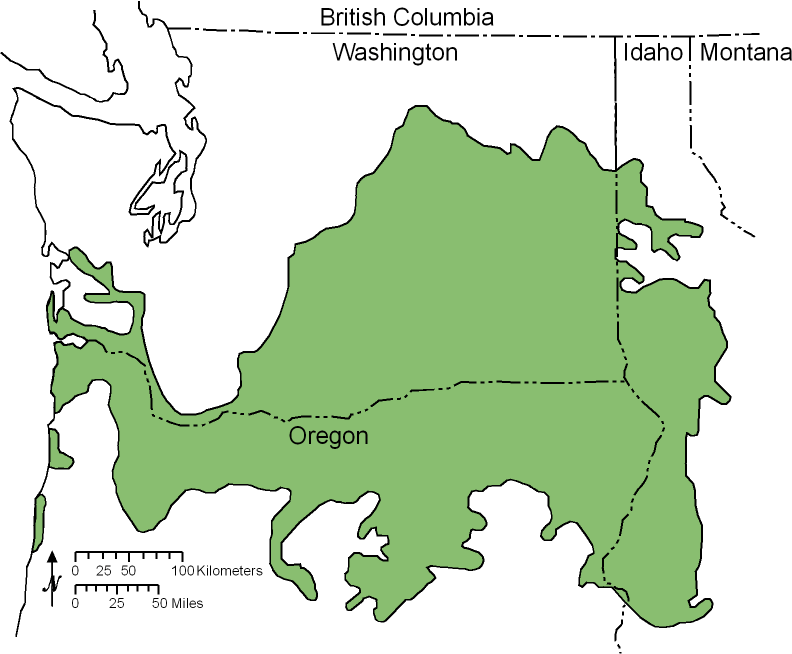
This particular argument is entirely based on the assumption that the current rate of volcanic activity in this particular region has always been the same throughout history. Clearly, this is not the case – especially in this particular region of the world. Volcanic activity has been much much greater in the past than it is today in numerous places around the world – especially in the Pacific Northwest. In the states of the Pacific Northwest, to include Washington State, hundreds of thousands of square miles of territory were engulfed by floods of basaltic lava (during the “Tertiary” or post-Flood period just a few thousand years ago) which must have flowed like huge rivers and stacked up layers thousands of feet thick. Volcanic activity on this scale is simply unheard of in the modern world. For example, the Colombia River Basalt Group (CRBG) of Washington State was rapidly created by numerous sequential lava flows that eventually reach more than 1.8 km (5,900 ft) in thickness (Link). The standard notion that these layers formed over several million years (from ~17 to 6 million years ago via radiometric dating methods) does not hold water due to several features of this formation:
Lack of Erosion:
One of the major problems with the idea that these flows span a period of over 11 million years of deposition is that there is significant physical evidence that the CRBG flows were deposited relatively rapidly with respect to each other. The average time between each flow works out to around 36,000 years. However, there is very little if any evidence of erosion between the layers. The very fact that these flows cover such great distances indicate that the individual flows traveled at a high rate of speed in order to avoid solidification before they covered such huge areas as they did. Also, there are several examples where two or three different flows within the CRBG mix with each other. This suggests that some of the individual flows did not have enough time to solidify before the next flow(s) occurred. If some 36,000 years of time are supposed to separate each of the individual flows where is the evidence of erosion in the form of valleys or gullies cutting into the individual lava flows to be filled in by the next lava flow? There are no beds of basalt boulders that one would expect to be formed over such spans of time between individual flows.
Some have suggested that the rates of erosion on these basalts was so minimal (< 0.5 cm/ka) that it would not have resulted in a significant change even after 36,000 years. However, a subsequent study by Riebe et. al. to determine the effects of various climatic conditions on erosion rates of granite showed that erosion rates averaged 4 cm per 1,000 years (ka) with a range of between 2 cm/ka and 50 cm/ka. What is especially interesting is that despite ranges in climate involving between 20 to 180 cm/yr of annual precipitation and between 4 to 15°C the average erosion rates varied by only 2.5 fold across all the sites and were not correlated with climate indicating that climatic variations weakly regulate the rates of granitic erosion (Link). Another paper by Lasaga and Rye, from the Yale University Department of Geology and Geophysics, noted that the average erosion rates of basalts from the Columbia River and Idaho regions is “about 4 times as fast as non-basaltic rocks” – to include granite (Link). This suggests that one could reasonable expect the erosion rate of basalts to average 16 to 20 cm/ka. Over the course of 36,000 years this works out to between 6 to 7 meters (19 to 23 feet) of vertical erosion. This is significant erosion and there should be evidence of this sort of erosion if the time gap between flow was really 36,000 years. So, where is this evidence?
For several other such flows in the United States and elsewhere around the world the time intervals between flows are thought to be even longer – and yet still there is little evidence of the erosion that would be expected after such passages of time. For example, the Lincoln Porphyry of Colorado was originally thought to be a single unit because of the geographic proximity of the outcrops and the mineralogical and chemical similarities throughout the formation. Later, this idea was revised after radiometric dating placed various layers of the Lincoln Porphyry almost 30 million years apart in time. But how can such layers which show little if any evidence of interim erosion have been laid down thousands much less millions of years apart in time?
Layers out of Order:
Other examples, such as the Garrawilla Lavas of New South Wales, Australia, are found between the Upper Triassic and Jurassic layers and yet these lavas, over a very large area, grade imperceptibly into lavas which overlie Lower Tertiary sedimentary rock (supposedly laid down over 100 million years later) (Link). Robert Kingham noted, concerning this formation, (during a 1998 Australian Geologic Survey Organization) that, “Triassic sediments unconformably overlie the Permian sequences. . . The Napperby depositional sequence represents the upper limit of the Gunnedah Basin sequence, with a regional unconformity existing between the Triassic and overlying Jurassic sediments of the Surat Basin north of the Liverpool Ranges. The Gunnedah Basin sequence includes a number of basic intrusions of Mesozoic and Tertiary rocks. These are associated with massive extrusions of the Garrawilla Volcanic complex and the Liverpool, Warrumbungle and Nandewar Ranges.” (Link). Now, isn’t it interesting that Tertiary sediments in the Gunnedah Basin sequence, which are thought to be over 100 million years younger, exist between Triassic and Jurassic sediments?
Massive Floods of Washington State:
What is also interesting along these lines is that the Scablands of Washington State, which were long thought to represent millions of years of erosion, were finally proved, by J Harlen Bretz against strong opposition for decades, to have been very rapidly created by catastrophic floods (Link). Very similar features are also seen in places like the Grand Canyon…
 DNA as a Natural Clock:
Dr. Hoehn:
If we can count the genetic differences between two women or two men and know the mutation rate with some accuracy, then we can know how long ago our common Adam and our common Eve lived. The problem for creationists in the past was that the Eve was dated at 200,000 years ago and the Adam at about 60,000 years ago, but recent studies have tended to make those dates converge.
David Poznik, et al. Science 02 Aug 2013: Vol. 341, Issue 6145, pp. 562-565 DOI: 10.1126/science.1237619
Archeology suggests that artifacts showing advanced cognitive abilities begin to appear about 70,000 years ago, if not before. So, placed together, DNA and archeology place Eden closer to 100,000 years ± 50,000 years ago. You have no text in your Bible to contradict those numbers. “In the beginning” is a statement of fact, but not a date. (Link)
Higher Mutation Rates using Known Historical Family Lineages:
Using the DNA mutation rate would be great as a natural clock if only we could determine how fast mutations were actually occurring in various regions of DNA (different regions of DNA mutate at different rates). The fact is that most of the DNA clocks are based on particular regions of mitochondrial DNA (mtDNA). So, how are the mutation rates determined for these regions of mtDNA? Well, most of the time evolutionary assumptions are used to estimate the mtDNA mutation rate – such as the evolutionary relationship between humans and apes or time spans based on radiometric dating methods rather than known historical dates. However, when known historical families are used to determine the mtDNA mutation rates various studies showed that the actual mutation rate was much higher than previously thought. These scientists were “stunned” to find that the mutation rate was, in fact, about 20 times higher at around one mutation every 25 to 40 generations (about 500 to 800 years for humans). It seems that in this section of the control region of mtDNA, which has about 610 base pairs, humans typically differ from one another by about 18 mutations. By simple mathematics, it follows that modern humans share a common ancestor some 300 generations back in time. If one assumes a typical generation time of about 20 years, this places the date of the common ancestor at around 6,000 years before present. But how could this be?!
 Thomas Parsons seemed just as mystified when he published similar findings in the journal Nature Genetics (April, 1997):
“The observed substitution rate reported here is very high compared to rates inferred from evolutionary studies. A wide range of CR substitution rates have been derived from phylogenetic studies, spanning roughly 0.025-0.26/site/Myr, including confidence intervals. A study yielding one of the faster estimates gave the substitution rate of the CR hypervariable regions as 0.118 +- 0.031/site/Myr. Assuming a generation time of 20 years, this corresponds to ~1/600 generations and an age for the mtDNA MRCA of 133,000 y.a. Thus, our observation of the substitution rate, 2.5/site/Myr, is roughly 20-fold higher than would be predicted from phylogenetic analyses. Using our empirical rate to calibrate the mtDNA molecular clock would result in an age of the mtDNA MRCA of only ~6,500 y.a., clearly incompatible with the known age of modern humans. Even acknowledging that the MRCA of mtDNA may be younger than the MRCA of modern humans, it remains implausible to explain the known geographic distribution of mtDNA sequence variation by human migration that occurred only in the last ~6,500 years.”
Modern Techniques have Solved the Problem:
Dr. Hoehn argues that things have improved since 1997, but they really haven’t. In his article he cites a 2013 paper by Poznik et al. However, “to compare the Y-chromosome genome to the mitochondrial genome,” Poznik et al. estimated their respective mutation rates by using phylogeographic patterns, or genetic patterns seen from geographic distributions, from a well known event – the settlement of the Americas 15,000 years ago (Link). In other words, the mutation rates used by Poznik et al. were calibrated based on radiometric dating methods. They were not based on known historical families. In fact, a year later (May, 2014) Jaramilloa et al. published a paper about mtDNA noting that:
“We also lack an accurate estimate of the germ-line mtDNA mutation rate in humans, with pedigree and phylogenetic studies producing conflicting results” (Link).
In this paper the authors specifically cited the work of Parsons et al. as the basis for their doubts regarding the actual mtDNA mutation rates over time – a problem for the mainstream position that simply hasn’t been resolved over time.
In response to this evidence, Dr. Hoehn argued (in the comment section associated with his original article – Link) that he wasn’t all that convinced that the DNA clock was very reliable after all – as an independent clock:
Dr. Hoehn:
“So… [you are right] if you accept a very fast rate of mutation, and the scientific consensus is right if you find a slower rate of mutation. I am willing to hold the question of the exact date of Adam and Eve’s creation as not yet established by the DNA clocks. But there are fossil remnants of humans that date with the independent C-14 radioactive clock to 40,000 years, and there are archeological remains of intelligent creatures including art and tools that radioactive date to 70,000 to 80,000 years ago. So for this reason alone it appears impossible to me for calculations for mutation rates that give dates closer to 10,000 years ago to be correct. The CSR folks have choosen mutation rates based on modern studies over a few short years, the slower rates are based on comparison with fossilized human remains and modern humans over 40,000 years, which is much more accurate as it is over a longer period of time than recent Anabaptists or Russian Czars.” (Link)
Again, for neo-Darwinists and theistic evolutionists like Dr. Hoehn, it all boils down to calibrations based on assumed evolutionary relationships or the assumed reliability of radiometric dating methods to support the longer ages that the Darwinists require. The strong evidence of much much faster DNA mutation rates based on direct analysis of several known historical family lineages is rejected, out of hand, for what reason? Because it simply doesn’t fit with the popular Darwinian paradigm of the day? and that is why mutation rates and dates based on radiometric dating assumptions are favored instead? Does anyone else see the obvious bias here? If the time indicated by a particular natural clock doesn’t fit with the primary paradigm, neo-Darwinists and theistic evolutionists either ignore that clock or make it appear to tick faster by calibrating it by another natural clock that appears to be more in line with the favored paradigm… which completely undermines Dr. Hoehn’s original claim that DNA mutation rates offer independent support for long ages of theistic evolution on this planet. Like all of the other dating techniques, DNA mutation rates have also been calibrated to “fit” properly with the favored paradigm while the evidence against this favored paradigm has been discarded because of an a priori philosophical position.
The Problem of the High Detrimental Mutation Rate:
Beyond this, the known overall DNA mutation rate is a problem for both evolutionists and old-Earth creationists as well. How so? Because, the vast majority of functional mutations are actually detrimental and because there are simply far far too many detrimental mutations, in each generation, for natural selection to effectively remove. What this means, then, is that all slowly reproducing creatures, to include all mammals as well as humans, are devolving – headed for eventual genetic meltdown and extinction. This also means that, contrary to the assertions of Dr. Hoehn, slowly reproducing living things could not have existed on this planet for even a million years – not by a long shot.
For more information on this particular problem of DNA mutation rates see: Summary of Detrimental Mutation Rates
 Radioactive Decay as a Natural Clock:
Dr. Hoehn:
As we introduced this topic, having multiple clocks increases our chance of knowing the right time. If several separate clocks agree on the age of an artifact, then our chance of being correct is increased. In addition to those radioactive clocks mentioned above there is Electron Spin Resonance, Thermoluminescence Dating, Fission Track Dating for glass-like minerals, Uranium/Thorium Dating, Oxidizable Carbon Ratio, Varve Analysis, and Obsidian Hydration Dating. Each technique has strengths, weaknesses, and range of time it can estimate, but the agreement of several methods on the same samples gives independent support to the validity of the age of the specimen.
Potassium-Argon Dating:
The problem with this argument is, of course, that these various methods are not really independent dating methods. The fact of the matter is that all of these methods must be calibrated by some other dating method. So, how or by what method(s) are they generally calibrated? Well, they are calibrated against each other – usually based on the potassium-argon method (K-Ar). For example, the Ar-Ar dating method must be first calibrated against the K-Ar dating method – according to the New Mexico Geochronology Research Laboratory:
Argon-Argon Dating:
“Because this (primary) standard ultimately cannot be determined by 40Ar/39Ar, it must be first determined by another isotopic dating method. The method most commonly used to date the primary standard is the conventional K/Ar technique. . . Once an accurate and precise age is determined for the primary standard, other minerals can be dated relative to it by the 40Ar/39Ar method. These secondary minerals are often more convenient to date by the 40Ar/39Ar technique (e.g. sanidine). However, while it is often easy to determine the age of the primary standard by the K/Ar method, it is difficult for different dating laboratories to agree on the final age. Likewise . . . the K/Ar ages are not always reproducible. This imprecision (and inaccuracy) is transferred to the secondary minerals used daily by the 40Ar/39Ar technique.” ( Link )
 Fission Track Dating:
Fission track dating is in no better shape. Faure (1986, pp. 345-346) mentions that fission track dating is calibrated (the “zeta calibration”) using rocks of “known” ages – which are themselves dated based on other radiometric dating methods (usually K-Ar). Also, because of numerous potential errors, most forms of fission track dating use a form of calibration or “comparison of spontaneous and induced fission track density against a standard of known age. The principle involved is no different from that used in many methods of analytical chemistry, where comparison to a standard eliminates some of the more poorly controlled variables. In the zeta method, the dose, cross section, and spontaneous fission decay constant, and uranium isotope ratio are combined into a single constant” (Link).
These problems have resulted in several interesting contradictions, despite calibration. For example, Naeser and Fleischer (Harvard University) showed that, depending upon the calibration method chosen, the calculated age of a given rock (from Cerro de Mercado, Mexico in this case) could be different from each other by a factor of “sixty or more” – – “which give geologically unreasonable ages. In addition, published data concerning the length of fission tracks and the annealing of minerals imply that the basic assumptions used in an alternative procedure, the length reduction-correction method, are also invalid for many crystal types and must be approached with caution unless individually justified for a particular mineral.” Now that’s pretty significant – being off by a factor of sixty or more?! No wonder the authors recommend only going with results that do not provide “geologically unreasonable ages”.
Varves:

 Like ice-core dating and tree ring dating, sedimentary layers in lake beds, or “varves”, as previously mentioned, are also not independent time clocks, but must also be calibrated based on other dating methods (Link). The same is true for amino acid racemization dating, which is also not an independent dating technique (Link).
Beyond the numerous problems with radiometric dating techniques, some of the most popular radiometric dating methods are often very inconsistent with other popular radiometric dating methods. For example, radiocarbon dating is very commonly used to date organic materials thought to be less than 100,000 years old (since C14 has a relatively short half-life of ~5,730 years).
 Dinosaur Soft Tissues and Radiocarbon:

In this light, consider the fairly recent discovery of original soft tissue remains within the bones of numerous dinosaurs thought to be more than 60 million years old (Link) – soft tissue that maintained flexibility and elasticity as well as cellular structure and original antigenic activity (based on fairly large intact portions of proteins). By itself, this finding was completely unexpected from the evolutionary perspective since it was long argued that soft tissues and proteins (even fragments of DNA) could not be maintained longer than 100,000 years or so due to the problem of kinetic chemistry where such organic molecules self-destruct (because of their constant movements/vibrations) over relatively short periods of time at ambient temperatures.
However, beyond this little conundrum, it has also been shown that such soft tissues contain significant quantities of radiocarbon (C14). Surprisingly, C14 has actually been discovered in the soft tissues of many dinosaur bones examined thus far, producing ages ranging from 16,000 to 32,000 years before present – essentially the same as the radiocarbon ages reported for large Pleistocene mammals such as mammoths, mastodons, dire wolves, etc. (Link, Link). Also, pretty much all coal samples contain fairly significant quantities of radiocarbon. The usual counterarguments of either contamination or in situ production don’t hold water when it comes to explaining the very high levels of radiocarbon so consistently and generally found throughout the fossil record (Link).
So, you see, radiometric dating isn’t exactly an overwhelming argument in favor of the Darwinian perspective on origins and certainly doesn’t overcome the strong evidence in favor of the biblical position on a literal 7-day creation week.
 Invoking Ellen White?

Dr. Hoehn:
The Great Controversy, Page 60. “The condition…presented a fearful and striking fulfillment of the words of the prophet Hosea: ‘My people are destroyed for lack of knowledge: because thou hast rejected knowledge, I will also reject thee, that thou shalt be no priest to me: seeing thou hast forgotten the law of thy God, I will also forget thy children.’ Hosea 4:6.” (Link)
What really amazes me is that Dr. Hoehn thinks to invoke Ellen White, of all people, to support his position on origins – on the existence and evolution of living things on this planet over the course of many hundreds of millions of years?! As Dr. Hoehn surely knows, Mrs. White was well aware of Darwinian arguments in her own day and she strongly opposed such arguments. She also strongly argued in favor of the literal nature of the 7-day creation week – in no uncertain terms. White writes what she was “shown in vision”:
“I was then carried back to the creation and was shown that the first week, in which God performed the work of creation in six days and rested on the seventh day, was just like every other week.… God gives us the productions of his work at the close of each literal day.” – EGW, SG, Vol. 3, p. 90.
“Like the Sabbath, the week originated at creation, and it has been preserved and brought down to us through Bible history. God Himself measured off the first week as a sample for successive weeks to the close of time. Like every other week, it consisted of seven literal days. Six days were employed in the work of creation; upon the seventh, God rested, and He then blessed this day, and set it apart as a day of rest for man.” – EGW, PP, p. 111
“But the assumption that the events of the first week required thousands upon thousands of years, strikes directly at the foundation of the fourth commandment. It represents the Creator as commanding men to observe the week of literal days in commemoration of vast, indefinite periods. This is unlike His method of dealing with His creatures. It makes indefinite and obscure that which He has made very plain. It is infidelity in its most insidious and hence most dangerous form; its real character is so disguised that it is held and taught by many who profess to believe the Bible.” EGW, PP, p. 111
How then can Dr. Hoehn think to invoke Mrs. White when it comes to considering his diametrically opposing view of origins? – a view that she calls “infidelity in its most insidious and hence most dangerous form”? – since it is “held and taught by many who profess to believe the Bible”? In short, either one accepts Mrs. White’s claims to have been divinely inspired and to have been given privileged information about the origin of life on this planet, or one must reject her claims as coming from a deluded mind. One simply cannot reasonably have it both ways.
The Bible’s Claims Regarding Origins:
 The Lion and the Lamb:

The authors of the Bible are in consistent agreement that the creation week was a literal week and that God created all life on this planet in such a way that death did not originally exist for sentient creatures. The Bible paints God as suffering and experiencing real pain whenever He sees even a little sparrow fall wounded to the ground (Matthew 10:29) or when He sees animals in general suffer and die (Jonah 4:11, Proverbs 12:10). It also paints God as wishing to create a place where sentient animals do not harm or eat each other – where lions, leopards, wolves, calves, lambs and little children, current natural enemies, co-exist happily and peacefully together in the world made new as it was originally intended to be (Isaiah 11:6). It is hard to imagine then that such a God would deliberately create using a painful and evil mechanism of the “survival of the fittest”, where carnivorous animals are “red in tooth and claw” in a place with untold amounts of suffering, pain, and death for billions upon billions of sentient creatures over vast eons of time, and then call it “very good” (Genesis 1:31).
A Bit of Interpretation:
Yet, when presented with the reality that the Bible does not support the concept of long-ages of suffering and death for sentient creatures before the fall of mankind, Dr. Hoehn responded as follows:
The more I look there is EVERYTHING outside of the Bible to suggest suffering and death for all kinds of creatures before the late arrival of men and women on this planet… [as is] so clearly testified in every fossil, every tar pit, every shale bed, every coal bed, every oil field, every Hawaiian island, every ice field, every drill core in the world, then he [Sean Pitman] is making the Bible false. If the Bible can’t be read and reinterpreted in a way to agree in concept with the facts of nature, then the Bible is falsified.
And this I am not willing to do. If I think the Bible says “White,” when the facts of nature say “Black,” it is time for me to reread and rethink my Bible. And all the creative arguments trying to make what is truly Black, look White through rose colored glasses become not only quixotic, but also harmful to the Bible. The Bible teaches us to love nature, and worship its God, it teaches us to love truth, and seek wisdom, nowhere does the Bible tell me to reject observable facts and bend them into cleverly designed fables to fit my preconceived interpretations of the Bible.
Dr. Pitman knows I am not any more Darwinian than he is. Old earth creationists are creationists, not atheists or agnostics, some of us are even Biblical inerrantists (I am not but some are). Yet we all interpret the Bible differently. Dr. Pitman’s claims rule out suffering and death because it says “good” and “very good” in Genesis. Isn’t it possible what is “good” and “very good” to God may be different to what Dr. Pitman thinks is “good?”
For example when God fights precreation darkness (with Satan and his angels lurking in it) with His light, the outcome of that battle God calls “good.” When God fights the pre-creation darkness of no atmosphere with a “firmament”, and progresses another step in Creation, God calls that “good” and that “goodness” doesn’t mean that billions of oxygen creating bacteria didn’t thrive and reproduce and die for ages, to make that “good” oxygen rich firmament.
So each Creation Day starts in “darkness” of some kind, and ends with “light” of God’s doing, and each stage that God was watching (God saw, the Bible says) when some fault, some deficiency, some failing of this earthly Satanic prison was battled through, God saying at the end of the struggle that it was “good” says nothing about how many life-forms lived, reproduced, and died to fashion a good place for the man and woman in his image.
At the end of a war, to say that the peace achieved and the victories won, and the dangers averted is “good” does not deny that there was much death and suffering to achieve that “good.”
I have found Bible references to death before Eve’s fall and have written about them in my Adventist Today print article referenced above.
So good for you Sean, you are a great battler for your conclusions. But since everything Outside of the Bible contradicts your present interpretation of the Bible, please consider using your talents to help the Bible agree with the overwhelming message of Nature by fashioning a theology of creation suitable for the testimony of nature.
(Link)
The main problem here, of course, is that Dr. Hoehn is willing to maintain the Bible as the “Word of God” regardless of what it actually says. In other words, the credibility of the Bible cannot really be tested against empirical reality. Why then should we take it to be anything more than an interesting and very ancient moral fable? – if the testable empirical claims of the Bible are demonstrably false?
Personally, I’m a believer in the Bible in particular as the Word of God, among all other competing options that make the same claim, because I see the Bible as unique with regard to the very strong empirical evidence in support of its claims. For me, the testable claims of the Bible have proven true while the claims of biblical critics throughout history have been consistently overthrown – to include the claims of modern neo-Darwinists.
The Clear Intent of the Biblical Authors:
Beyond this, the biblical authors are not ambiguous with regard to the issue of origins. They make very specific empirical claims regarding how long God took to create life on this planet – just seven literal days. There really is no valid counter argument here. After all, even secular scholars of Hebrew agree that the authors of the Bible, especially the Genesis account, all intended to convey to their readers that the creation week took place during seven literal days. There is simply no rational basis to argue otherwise. The texts are quite clear in their intent. Even Jesus taught that the Genesis account of origins was a literal account (Matthew 19:4 & 24:37). Again, even secular scholars understand this. Take, for example, the comments of well-known Oxford Hebrew scholar James Barr:
Probably, so far as I know, there is no professor of Hebrew or Old Testament at any world-class university who does not believe that the writer(s) of Genesis 1–11 intended to convey to their readers the ideas that: (a) creation took place in a series of six days which were the same as the days of 24 hours we now experience. (b) the figures contained in the Genesis genealogies provided by simple addition a chronology from the beginning of the world up to later stages in the biblical story (c) Noah’s flood was understood to be world-wide and extinguish all human and animal life except for those in the ark. Or, to put it negatively, the apologetic arguments which suppose the “days” of creation to be long eras of time, the figures of years not to be chronological, and the flood to be a merely local Mesopotamian flood, are not taken seriously by any such professors, as far as I know.
Letter from Professor James Barr to David C.C. Watson of the UK, dated 23 April 1984.

Right up front, then, Dr. Hoehn is being inconsistent. He is trying to maintain the Bible as “The Word of God” while interpreting important empirical claims found in the Bible contrary to the obvious intent of the biblical authors. Of course, he is not alone in this effort. But why do so many feel so compelled to try to twist and distort the clearly intended message of numerous biblical authors? Well, Dr. Hoehn, and many others like him, are trying to live in two different worlds – a conservative religious Bible-believing word and a largely secular neo-Darwinian world. The Biblical world view provides meaning and hope while the neo-Darwinian world view is held by the most intelligent, well-educated, and intellectual people in modern society – a society within which those like Dr. Hoehn wish to be taken seriously. There is, therefore, obvious motivation to maintain key elements of both world views – if possible.
The Implications of Long Ages of Life and Death:
While I sympathize with those who honestly find themselves where Dr. Hoehn seems to have arrived in his thinking, the problem is that such efforts remain inconsistent – a fact that even Darwin himself recognized early on. For example, William Provine, late professor of biological sciences at Cornell University, gave a very interesting speech for a 1998 Darwin Day keynote address in which he pointed out the following:
Naturalistic evolution has clear consequences that Charles Darwin understood perfectly.
- No gods worth having exist;
- No life after death exists;
- No ultimate foundation for ethics exists;
- No ultimate meaning in life exists; and
- Human free will is nonexistent.
Provine, William B. [Professor of Biological Sciences, Cornell University], “Evolution: Free will and punishment and meaning in life”, Abstract of Will Provine’s 1998 Darwin Day Keynote Address.

Provine also wrote, “In other words, religion is compatible with modern evolutionary biology (and indeed all of modern science) if the religion is effectively indistinguishable from atheism.” – Academe January 1987, pp.51-52
It seems to me that Provine, contrary to the claims forwarded by Dr. Hoehn, was right and was most consistent with the implications of accepting neo-Darwinian claims of long-ages of living things evolving and dying on this planet. Even if it is accepted that God’s hand was involved in this process, a form of evolution by deliberate design so to speak, such a conclusion paints God in the most unattractive light possible – as downright evil in fact.
False Advertising:
Regardless, let’s say that Dr. Hoehn is right and that the SDA Church is wrong, but the SDA Church doesn’t realize its mistake. Why then doesn’t Dr. Hoehn just leave the SDA Church to join another church that more accurately reflects his own views? I for one, even though I’ve grown up in the Adventist Church and way of life, would not long remain in the church if I ever became convinced that the arguments forwarded by Dr. Hoehn were actually correct. For me, being a member of a church organization is more than just being a member of a nice social club. It’s a public assent to the primary goals and ideals of the organization to which I belong. Otherwise, for me, it’s nothing more than false advertising.
_____________
Short List of Natural Clocks that Favor a Literal Creation Week:
- Continental erosion rates: Time constraint: < 10 million years ( Link )
- Mountain sedimentary layer erosion rates: < 10 million years ( Link )
- Ocean sediment influx vs. subduction: < 5 million years ( Link )
- Detrimental mutation rate for humans: Extinction in < 1 million years ( Link )
- Radiocarbon in dinosaur fossils, coal, and oil: < 100,000 years ( Link )
- Preserved proteins in fossils: < 100,000 years ( Link )
- Paraconformities: < 10,000 years ( Link )
- Erosion rates between layers: < 1,000 years per layer ( Link )
- Pure thick coal beds: < 100 years ( Link )
- Minimal bioturbation between layers < 5 years per layer ( Link )
- Worldwide paleocurrent patterns: < 1 year ( Link )
Such time constraints are far more consistent with catastrophic events vs. mainstream thinking which seems to be off from the maximum allowable ages suggested above by several orders of magnitude…


